Direct answer: The food cost formula in plain terms, a real worked example, and the prep- and cooking-loss adjustments that make most spreadsheets wrong.
The food cost formula is simple to write down and easy to get wrong. The formula itself is one line; the part that trips up most kitchens is what you put into it. Get the inputs right and you can price every dish with confidence and see your real margin before it reaches the menu.
This guide gives you the formula, a real worked example costed in FoodTechGuru, and the adjustments that separate an accurate number from a hopeful one.
The food cost formula
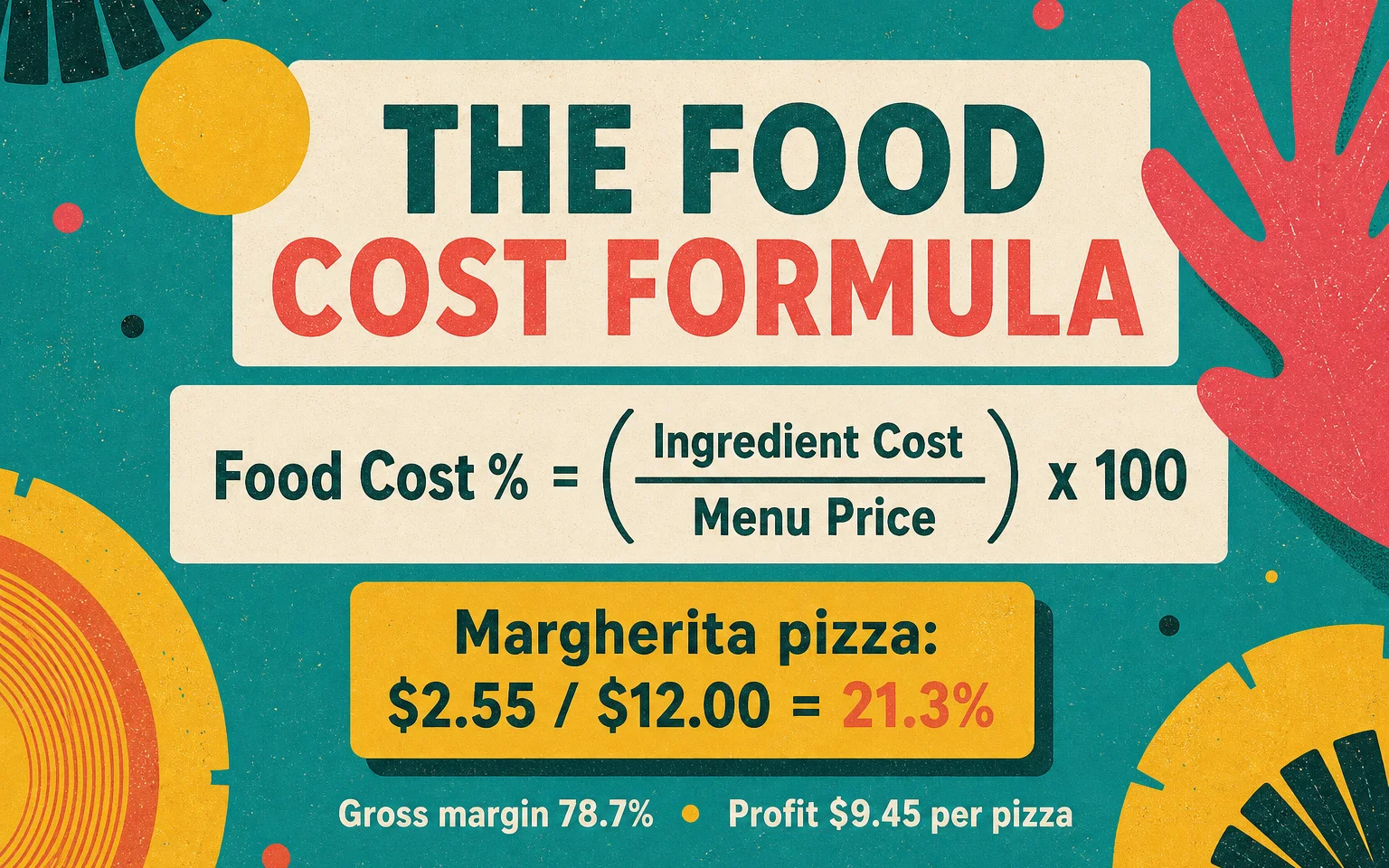
> Food cost percentage = (ingredient cost ÷ menu price) × 100
If a dish costs $2.55 in ingredients and sells for $12.00, the food cost is 2.55 ÷ 12.00 × 100 = 21.3%. The other 78.7% — $9.45 per plate — is your gross margin before labour, rent, and overhead.
To price from a target food cost, run it backwards:
> Menu price = ingredient cost ÷ target food cost percentage
A $2.55 plate at a 28% target would price at 2.55 ÷ 0.28 = $9.11; at $12.00 you are comfortably under target.
What actually counts as "ingredient cost"
The formula is only as good as the ingredient cost you feed it. The number is not the invoice price times the recipe weight — it is the cost of everything you have to buy to put one finished portion on the plate:
- Purchase price — what you pay your supplier, per kilogram or unit.
- Recipe quantity — the grams of each ingredient in one portion.
- Prep loss (yield) — trim, peel, and waste you pay for but never serve.
- Cooking loss — weight lost to heat for ingredients that cook down.
Multiply quantity by price for each ingredient, add the loss you can't sell, and sum the lines. Skip steps 3 and 4 and the formula quietly understates your food cost on almost every dish.
Worked example: a $12.00 Margherita pizza
Here is a real cost card generated in FoodTechGuru for a single 12-inch Margherita pizza, using US food-service prices — the exact numbers, not an illustration. Change a price or a quantity and every total recalculates, exactly as it does in the app.
Add the dough, sauce, mozzarella, basil, and oil and the pizza costs $2.55. At a $12.00 menu price that is a 21.3% food cost and a 78.7% gross margin — typical for pizza, where cheap, shelf-stable ingredients carry a strong margin.
The same card is also a shareable, read-only Google Sheet — open the cost sheet, or read the colour-coded card below (yellow = input weights, blue = loss factors, green = calculated), down to the Total Initial Weight row:
Food cost percentage vs gross margin
These two numbers are the same fact from opposite directions. Food cost % = ingredient cost ÷ price. Gross margin % = 1 − food cost %. The pizza's 21.3% food cost is its 78.7% margin.
Use food cost percentage to price a dish against a target; use gross margin (in dollars, not just percent) to decide which dishes to push. A high-margin-percentage dish that sells two a week earns less than a moderate-margin dish that flies out of the kitchen.
Common food cost formula mistakes
- Using the invoice price, not the yield price. A vegetable that loses 20% in trimming costs ~25% more per usable kilogram than the invoice says.
- Costing raw weight for a cooked portion. Protein that loses 25% on the grill costs more per gram served than per gram bought.
- Forgetting the small lines. Oil, salt, garnish, and sauce are individually tiny and collectively a few percent of food cost.
- Pricing on percentage alone. A 20% dish can lose money if it is slow to make or needs costly packaging; margin in dollars is the tiebreaker.
How FoodTechGuru does the math for you
Building a cost card by hand takes time, and the loss factors are easy to forget. FoodTechGuru turns a recipe — typed, photographed, dictated, or pasted from an Instagram, TikTok, or YouTube link — into a structured cost card with prep and cooking loss applied, gross purchasing weight, cost per serving, food cost %, and margin, and exports it to Google Sheets for free.
New to this? Try the food cost calculator for a quick estimate or the recipe cost calculator to cost a full recipe, then let the app generate the complete card. FoodTechGuru is available as an iOS app (Android is coming), with free credits to cost your first dishes. Download it on the App Store.
FAQ
What is the food cost formula? Food cost percentage = (ingredient cost ÷ menu price) × 100. Example: $2.55 ingredient cost ÷ $12.00 menu price × 100 = 21.3%.
How do you calculate food cost percentage? Add the true cost of every ingredient in one serving — including prep loss and cooking loss — then divide by the menu price and multiply by 100.
How do you price a dish from a target food cost? Reverse the formula: menu price = ingredient cost ÷ target food cost percentage. A $2.55 plate at a 28% target prices at $9.11.
Why is my calculated food cost too low? Most spreadsheets use the invoice price and the recipe weight only, ignoring trim and cooking loss — so the real cost of what you serve is higher than the formula shows.
Build It Faster In FoodTechGuru
FoodTechGuru turns recipes, photos, and kitchen notes into cost cards with prep loss, cooking loss, labour, utility, and price logic already structured for operators.