
Business plans · Food truck format
Ice Cream Truck Business Plan
An ice cream truck business plan has to pay a full year of costs from a short season. Use this outline, test your scoops-per-day break-even below, then build the Google Sheet from your own menu in the FoodTechGuru app, using its Food truck format.
Create your business planDownload the outline (.docx)- $60,650opening equipment in the starter list
- $1,750monthly costs to start from
- $5,430starter labour a month
Open a real finished plan
See a finished plan from the app
We have not filmed a ice cream truck plan yet, so this is the Google Sheet the app generated for our taco truck demo, Rio Taco Truck. Your workbook has the same seven tabs with your numbers.
- $74,415to start
- $3,349net profit a month
- 131portions a day to break even
- −$87,342lowest cash point, month 5
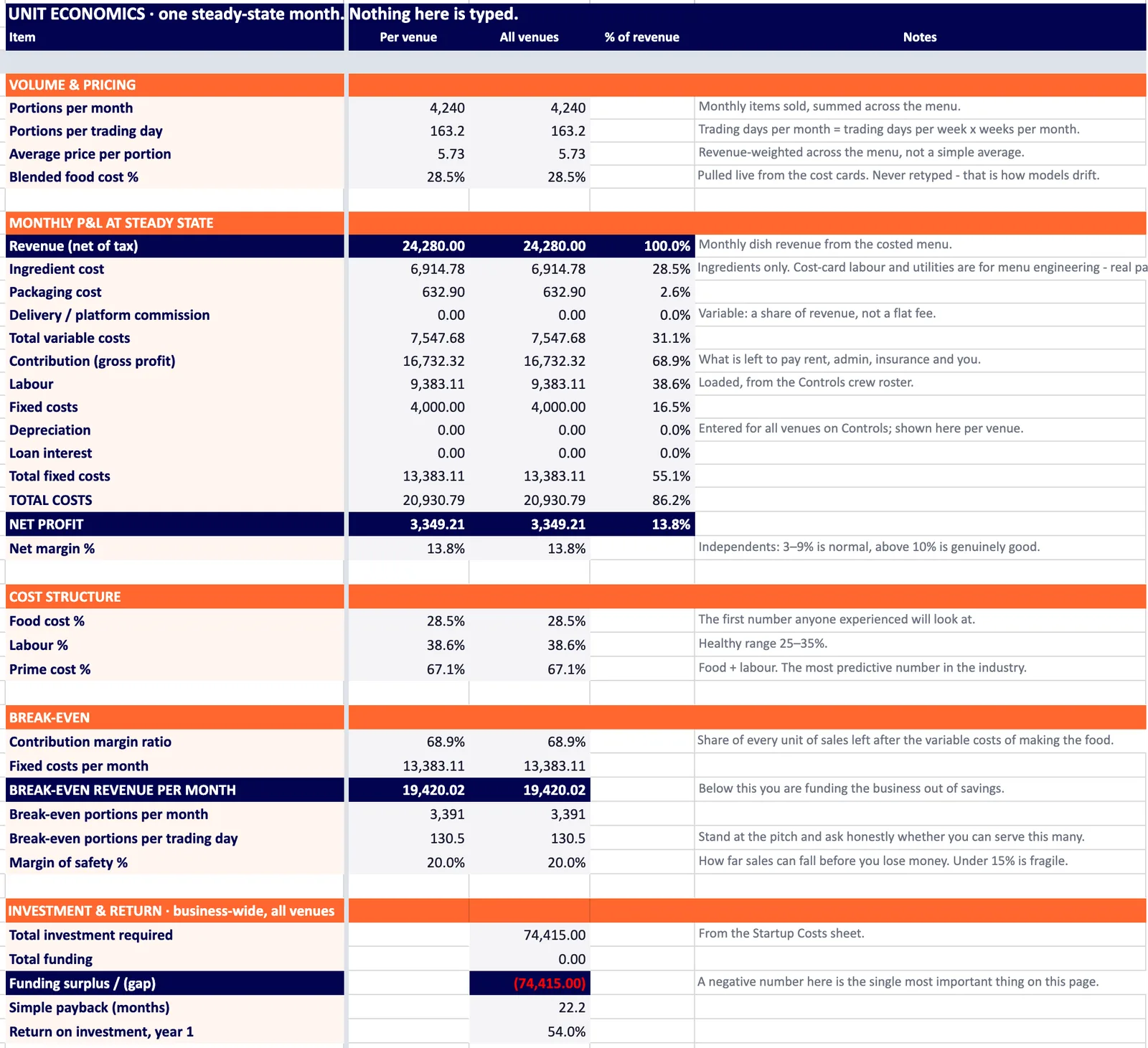
A view-only example of a food truck. Its figures are not a forecast for your business.
The seven sections
What goes in a ice cream truck business plan
You write the sections that need your judgment. The workbook gives you the numbers for the rest.
Executive summary
One page, written last: your season, your routes and events, the money you need and when a full year pays it back.
Concept and customers
Neighborhood routes, parks, or booked events and parties. Bookings pay a set fee, and routes depend on the weather.
Market and competition
Find out whether your city limits street vending and which trucks already work your area. Note their prices and their routes.
Menu and pricing
A cost and price for each serving. Cones, cups and toppings belong on the card.
Marketing plan
Where the truck is today, how parents book a party and a month of bright posts in the weeks before opening.
Operations and team
Season start and end, routes, the freezer and power setup, storage in winter. Permits vary by city, so list yours.
Financial plan and funding
One in-season month, then twelve months of cash with the winter included, and the budget for the truck and freezers.
Keep this as a template. The Word file has these seven sections with their prompts and a list of the numbers to bring. It is free with your email.
Download the outline (.docx)Food truck format · what the app pre-fills
The numbers the app starts you with
An ice cream truck uses the Food truck format. We crossed out the griddle, fryer and hood. The freezer stays, and you add your own soft-serve or dipping cabinet quote. The same list is editable in the app.
Opening crew
| Role | People | Hours/wk | Pay/h |
|---|---|---|---|
| Owner | 1 | 45 | $0 |
| Cook | 1 | 40 | $18 |
| Service | 1 | 30 | $14 |
| Labour a month, with 10% employer costs | $5,430 | ||
The app opens owner pay at $0. The workbook warns: “A plan that only works when you work free is not a plan.”
Monthly base
| Rent / pitch | $900 |
| Utilities / fuel | $350 |
| Insurance | $150 |
| Repairs & maintenance | $150 |
| Marketing | $200 |
| Fixed costs a month | $1,750 |
Opening equipment
| Food truck | $50,000 |
| Commercial griddle | $2,500 |
| Countertop fryer | $1,500 |
| Undercounter refrigerator | $1,800 |
| Compact freezer | $1,200 |
| Stainless prep counter | $750 |
| Sink and water system | $1,500 |
| Ventilation and extraction | $3,000 |
| Generator and power setup | $2,200 |
| Point-of-sale terminal | $700 |
| Opening packaging stock | $800 |
| Smallwares starter set | $1,200 |
| Fire and safety equipment | $500 |
| Equipment | $60,650 |
| With the workbook's 10% contingency | $66,715 |
Add your soft-serve machine or dipping cabinet quote here. The app has no starter price for it, so we left it out of the total.
- The app models one steady month, so enter a typical in-season month as your menu and sales.
- To model winter, open the Cash Flow tab. Each month has a yellow growth cell and a yellow crew headcount cell. Lower growth in autumn, raise it again in spring and cut the crew for the months you park the truck. Never enter 0 for growth, because each month builds on the last: use 0.1, then 10 to come back. The app has no separate season setting yet.
- Keep venues trading at 1 through the winter. At 0 the sheet also drops your fixed costs, and your insurance and storage bills keep coming while the truck is parked.
Free, in your browser
Test your ice cream truck break-even
Costs below are the Food truck starters from the table above. Prices and sales are our sample menu, so replace them with yours. The math and the verdicts match the workbook's Unit Economics tab.
- Sales a month
- Net profit a month
- Net margin
- Simple payback
- Food cost
- Labour
- Prime cost
- Net margin
- Margin of safety
Labour reads high? The workbook says it is “usually a rota problem, not a wage problem.”
What you get back
Seven tabs. 1,800+ live formulas. Every formula already connected.
Not a PDF that goes stale. The plan is a working spreadsheet model — yellow cells are your inputs, everything else is a formula. Change a price, and break-even, profit and cash flow follow.

- 1
Controls
Every setting in one place: format, currency, venues, trading days, crew, monthly base, delivery channels, targets.
- 2
Unit Economics
One steady month, per venue and for all venues. Profit, prime cost, break-even, payback and a health check with what to fix.
- 3
Cash Flow
Twelve months with a growth multiplier, staged venues, CAPEX and funding — and the lowest cash point you must survive.
Each month has its own yellow growth and crew cells, which is how you model the off-season.
- 4
Menu Engineering
The same columns as the app's menu calculation. Every dish classed Star, Plowhorse, Puzzle or Dog by margin and popularity.
- 5
Cost Cards
Every dish's cost card on one tab — ingredients, gross weights, prep and cooking loss, cost per portion.
Cost per serving, with the cone or cup on the card.
- 6
Purchase List
Your buying list, aggregated across the menu in gross weight and grouped by category — with an integrity check against the menu.
- 7
Startup Costs
One-off money with estimated, actual and variance columns, plus how it's funded: owner cash, loans, investors.
How it works
Six simple questions to start your plan cooking.
Tap any step to watch it on the phone. Every step feeds a real tab in your Google Sheet.
-
Pick the closest format and how many days a week you'll trade. For this plan that is Food truck. It only shapes the suggestions; you can change every number.
Feeds Controls
-
Build your opening crew by role — owner, cook, prep, service, driver, manager — then tune hours per week, hourly pay and employer costs. Leave pay at zero for an unpaid role.
Feeds ControlsCash Flow
-
Choose the menu this plan will sell. Food costs come straight from its recipe cost cards and stay read-only; you set prices and how many of each dish you expect to sell a month.
Feeds Menu EngineeringCost CardsPurchase List
-
The costs that keep the doors open whatever you sell: rent or pitch, utilities or fuel, insurance, marketing, software, repairs and professional fees.
Feeds ControlsUnit Economics
-
Start from an editable equipment and opening-setup list for your format. Adjust quantities and prices, remove what you already own, add anything missing.
Feeds Startup CostsCash Flow
-
Your economics on one screen: break-even portions per day, revenue, profit, food, labour and fixed costs. Slide selling prices and sales volume to stress-test the plan.
Feeds Unit Economics
-
One tap on Generate Business Plan Google Sheet. It costs every dish, works out your monthly numbers and projects twelve months of cash flow — about a minute, and you can leave the screen.
-
A live formula workbook that opens from a link. Change a yellow input and break-even, profit and cash flow follow. Make a copy to keep it in your own Google Drive before you share it.
All 7 tabs
 Food truckMobile, lean and full of personality
 CaféCoffee, bites and loyal regulars
 RestaurantA complete dine-in experience
 BakeryFresh batches and counter sales
 Ghost kitchenDelivery-first and highly focused
 CateringEvents, groups and planned production



 Rent / pitch
 Utilities / fuel
 Insurance
 Repairs & maintenance
 Marketing


Phone screens are a recreation. Crew, monthly costs and equipment are the app's real Food truck starters, as edited above. The menu and sales are a sample with owner pay at $0, so they are not a forecast.
Section 5 of your plan
The marketing section needs real posts behind it
Parents book the truck they have seen. FoodPerfect, our sister product, turns your phone photos into bright dish shots, designs offers with your real prices and fills a month of posts for you to approve before the season starts.
Each product does its own job, and nothing syncs between them yet. You enter your dish names and prices in FoodPerfect yourself.
See FoodPerfect for food trucks: $3 free to start, no card ↗

Ice cream truck business plan FAQ
How do I model a seasonal ice cream business in the plan?
Enter an in-season month in the app. Then open the Cash Flow tab, lower the yellow growth cells for your off-season months and cut the crew headcount cells for the months you park the truck. Your lowest cash point shows how much money you need to carry through winter. A dedicated season setting is not in the app yet.
How much does the app assume an ice cream truck costs?
The Food truck format starts at $67,650 of equipment including a $50,000 truck. Without the griddle, fryer and hood it is $60,650, or $66,715 with 10% contingency, before your soft-serve or dipping cabinet. A used truck can change this by a wide margin.
How many servings do I need to sell a day?
With the starter crew, starter costs and our sample menu, break-even comes to 73 servings a day over five trading days a week. Run the calculator with your own numbers, and remember a season month has to cover your winter as well.
What does FoodTechGuru write, and what do I write?
The app builds the financial section: costed menu, crew, monthly costs, startup budget, break-even and twelve months of cash. You write the concept, the market research and the operating detail, because those need your town and your judgment.
What does a business plan cost in the app?
The app is a free download, and you can open and edit the finished Sheet on any computer. Generating a business plan uses 50 credits and needs a paid Pro or Guru subscription. The Guru trial does not include business plans. Regenerating the same plan is free. The app runs on iPhone today.
Can I send the Sheet to a bank or a partner?
Yes, once you make your own copy. Your plan opens from a link, and anyone with that link can edit it. Use File, Make a copy to keep it in your own Google Drive, or File, Download to send an Excel file.
See the whole thing
Watch a full plan come together
This two-minute film follows a dark kitchen from cost cards to menu engineering to the finished Google Sheet. An ice cream truck business plan uses the same steps with your own recipes.
Build your ice cream truck plan from your own menu.
Cost your menu, choose Food truck, swap in your freezers and open the workbook about a minute later.